

Which Deal Is Actually Profitable?
If you own multiple rental properties across separate LLCs, you probably know your portfolio is making money. What you might not know: which deal is actually profitable.
Here's why that matters more than most operators realize.
The blended books problem:
Most small real estate operators start simple — one bank account, one QBO file, maybe a spreadsheet. It works for one deal. By deal three, it's a liability.
When income and expenses from multiple LLCs are mixed together, your financial picture becomes an average. A strong deal masks a weak one. A property with deferred maintenance looks fine on paper until it doesn't. You can't make a good hold/sell decision on blended numbers.
What entity-level reporting actually looks like:
Each LLC gets its own QBO file. Each file gets a monthly close — reconciled bank accounts, categorized expenses, and a clean P&L and balance sheet. Every month, you know:
* What each property brought in
* What it cost to operate
* What it netted
That's not a luxury. That's the minimum information you need to manage a portfolio intelligently.
What I see in practice:
St. Louis real estate operators running 3–5 deals are often working off a single blended QBO file, a CPA who sees the books once a year, and a general sense that things are probably fine.
They're usually right. But "probably fine" is not a portfolio management strategy.
The operators who scale past 5 deals consistently are the ones who have clean entity-level books before they need them — not after.
The fix is simpler than it sounds:
Separate QBOs. Monthly close by entity. One reporting package that gives you the full picture across your portfolio each month.
If your books don't currently give you a P&L by property — that's the first thing worth fixing.
I do exactly this for St. Louis real estate operators. Flat-rate monthly pricing, no surprises.

Why Clean Books Are Your Best Tool Before a Refinance
St. Louis real estate developers: disorganized financials can kill a refinance before it starts. Here's exactly what lenders want to see — and how to be ready.
One of the fastest ways to slow down a refinance is handing your lender a pile of disorganized financials.
I've seen it happen with experienced developers. The deal is solid. The property performs. But when the lender asks for documentation, the books aren't in shape to support it — and what should be a 30-day process turns into 90 days of scrambling, amended reports, and follow-up requests.
It's a fixable problem. But it's a lot easier to fix before you're under contract than after.
What Lenders Actually Want to See
For a small developer with multiple entities — which describes most of the operators I work with here in St. Louis — lenders are typically looking for four things:
1. Entity-level P&Ls
Not a consolidated view. Not a year-end summary. They want to see income and expenses broken out by entity, so they can evaluate each project on its own merits. If your books commingle multiple LLCs into a single QBO file, that's a problem you need to solve before the request hits your inbox.
2. Rent rolls reconciled to deposits
A rent roll on a spreadsheet is easy to produce. A rent roll that ties directly to your bank deposits — month by month, tenant by tenant — is what actually holds up to scrutiny. Lenders have seen enough optimistic projections to know the difference between what an owner says they're collecting and what the bank confirms.
3. Debt service coverage you can actually support with numbers
DSCR requirements vary by lender and loan type, but the underlying question is always the same: does the property generate enough income to cover its obligations? If your bookkeeping doesn't clearly separate operating income from owner draws, intercompany transfers, or one-time items, your real coverage ratio is obscured — even if the number is actually good.
4. A clear picture of intercompany balances
If you're running multiple project entities that borrow from or lend to each other, or that share expenses through a management company, those relationships need to be documented and reconciled. Unexplained intercompany balances are a red flag. Clearly documented ones are not.
None of This Is Hard — If the Books Are Current
Every item on that list is straightforward to produce when the books have been kept up. The entity-level P&L is already there. The bank reconciliation confirms the rent roll. The DSCR calculation takes minutes. The intercompany balances are already documented.
None of it is hard. It just requires that someone has been doing the work every month.
When that hasn't happened — when books are six months behind, accounts haven't been reconciled, and equity balances haven't been touched since the CPA filed last year's return — the preparation process becomes the transaction. Instead of closing your refinance, you're rebuilding your financial records under time pressure, while your lender waits.
The Real Cost of Disorganized Books
Developers tend to think about bookkeeping as a compliance expense — something you do because you have to, not because it creates value.
The refinance timeline changes that calculation fast.
A delayed close has real carrying costs. If you're refinancing to pull equity into a new deal, a 60-day delay in closing can mean a missed acquisition. If you're refinancing out of a construction loan, rate exposure during the delay can cost more than a year of bookkeeping fees.
Most developers I talk to here in St. Louis have a deal in some stage of financing at any given time. That's exactly when clean books pay for themselves — not as an accounting exercise, but as a competitive advantage.
What "Ready for a Refinance" Looks Like in Practice
If you're a developer managing multiple project LLCs, here's what your books should look like at any given moment:
Every entity has its own QBO file, or classes are properly segregated within a shared file
Bank and credit card accounts are reconciled monthly, with no older-than-30-day unreconciled items
Loan balances reflect actual outstanding principal, not just original draw amounts
Intercompany transfers are coded to a due-to/due-from account, not buried in miscellaneous expenses
Rent deposits are coded by tenant or unit, making rent roll reconciliation straightforward
Year-end financials tie to the tax return — no unexplained variances between the two
If that's where your books are, you can respond to a lender document request in days, not weeks. If it's not, the gap between where you are and where you need to be is exactly the kind of work 314 Bookkeeping handles.
Working With a St. Louis Bookkeeper Who Understands Real Estate
There's a meaningful difference between a bookkeeper who understands real estate development and one who doesn't.
The chart of accounts matters. The way draws and distributions are handled matters. The way intercompany loans are documented matters. These aren't exotic accounting concepts — but they require someone who has worked inside a multi-entity real estate structure and knows what a lender, a CPA, or a title company is actually looking for.
314 Bookkeeping is a St. Louis-based bookkeeping firm built specifically for small business owners and real estate developers who need accurate books, reliable reporting, and a dedicated bookkeeper — without the overhead of a full-time hire.
If you're a St. Louis developer running one to five deals across multiple LLCs and you don't have a bookkeeper keeping your records current, let's talk before your next refinance — not during it.
Schedule a free consultation at 314bookkeeping.com
Brandon Barchet is the founder of 314 Bookkeeping, a St. Louis-based bookkeeping firm serving small businesses and real estate developers. He brings controller-level experience managing multi-entity real estate structures and specializes in QuickBooks Online bookkeeping for developers, investors, and small business owners across the St. Louis market.

Who Is 314 Bookkeeping — and Is It the Right Fit for You?
314 Bookkeeping provides flat-rate monthly bookkeeping for St. Louis small businesses and real estate developers. Clean books. Consistent close. Reporting your CPA can use.
If you've landed on this page, you're probably a St. Louis small business owner or real estate developer who needs clean, consistent books — and you're trying to figure out who to trust with them. Here's the short version of who I am and how I work.
About Brandon Barchet and 314 Bookkeeping
I'm Brandon Barchet, founder of 314 Bookkeeping — a St. Louis-based bookkeeping firm built specifically for small businesses and independent real estate developers.
Before starting 314 Bookkeeping, I spent 15+ years in accounting, including controller-level work for a commercial real estate developer. That background means I'm not learning on the job when it comes to entity-level reporting, multi-LLC structures, or the financial details that matter most to developers operating in the St. Louis market.
314 Bookkeeping is not a CPA firm, and that's intentional. I focus on one thing: bookkeeping done right, every month, without exception. Clean books. A consistent monthly close. Financial reports your CPA can actually use.
Who I Built This For
Small Business Owners in St. Louis
If you're running a business with 1 to 15 employees and generating somewhere between $100,000 and $2 million in annual revenue, you likely don't need a full-time bookkeeper — but you do need someone who treats your books like a real business asset, not an afterthought.
I work with owners across a range of industries in the St. Louis area, including:
Trades and contractors — plumbers, electricians, HVAC, general contractors
Restaurants and retail — single-location operators and small multi-unit owners
Professional services — consultants, agencies, medical practices
E-commerce businesses — product sellers managing inventory and multi-channel revenue
Health and wellness — gyms, studios, practitioners, and clinics
If you're currently doing your own books in QuickBooks, running behind on reconciliations, or handing your CPA a mess every April — I can fix that.
Real Estate Developers Running Multiple LLCs in St. Louis
This is where my background becomes a direct advantage.
If you're a St. Louis City developer running 1 to 5 deals across multiple LLCs — and you don't have a dedicated bookkeeper — you're almost certainly losing time, creating reporting blind spots, and making your CPA's life unnecessarily complicated.
The most common problems I see with developers in this position:
Intermingled expenses across entities that should be tracked separately
No entity-level P&L — making it impossible to evaluate deal performance clearly
Inconsistent cash tracking across construction draws, operating accounts, and distributions
Books that are months behind — meaning no current picture of where any deal actually stands
My background in real estate development accounting means I understand how these entities work, how to structure the books for each one, and how to produce the reporting your CPA and investors need. You get a monthly close, accurate entity-level financials, and a single point of contact who understands the work.
How 314 Bookkeeping Works
Everything is delivered on a flat monthly rate through QuickBooks Online. No hourly billing, no surprise invoices — just a predictable monthly cost for books that are always current.
Services include:
Monthly transaction categorization and reconciliation
Monthly close and financial statement preparation (P&L, Balance Sheet)
Entity-level reporting for real estate developers with multiple LLCs
Accounts payable and receivable tracking (Professional and Controller tiers)
Cash flow forecasting and KPI reporting (Controller tier)
Catch-up and cleanup bookkeeping for books that are behind
CPA-ready year-end package
I complement your CPA — I don't compete with them. If you already have a tax professional you trust, I'll work directly alongside them. If you need a referral to a St. Louis CPA, I can point you in the right direction.
Why St. Louis Developers and Business Owners Work With 314 Bookkeeping
Local knowledge, not a national platform. 314 Bookkeeping is built in St. Louis, for St. Louis. I'm not a software-driven service routing your books through a remote team. You have one point of contact — me — and I know the St. Louis market.
Controller-level real estate background. Most bookkeepers have never worked inside a real estate development operation. I have. That experience is the difference between books that technically reconcile and books that actually tell you how your deals are performing.
Transparent, flat-rate pricing. Most bookkeeping firms in St. Louis won't tell you what they charge until after the discovery call. My pricing is published — you can see exactly what each service tier costs before you ever pick up the phone.
Month-to-month. No annual contracts. You stay because the work is good.
Ready to Get Your Books in Order?
Whether you're a St. Louis small business owner looking for a reliable monthly bookkeeper, or a developer managing multiple LLCs who needs entity-level reporting done right — I'd like to talk.
Visit www.314bookkeeping.com to see pricing and get in touch.
Brandon Barchet
314 Bookkeeping | St. Louis, MO
brandon@314bookkeeping.com | 636-577-0639
Clean Books | Consistent Close | Reporting You Trust.
The Multi-LLC Problem: Why Real Estate Developers in St. Louis Need Dedicated Bookkeeping
Running multiple LLCs for your St. Louis real estate deals? Learn why dedicated bookkeeping matters for developers — and what clean entity-level books actually look like.
By Brandon Barchet | 314 Bookkeeping | St. Louis, Missouri
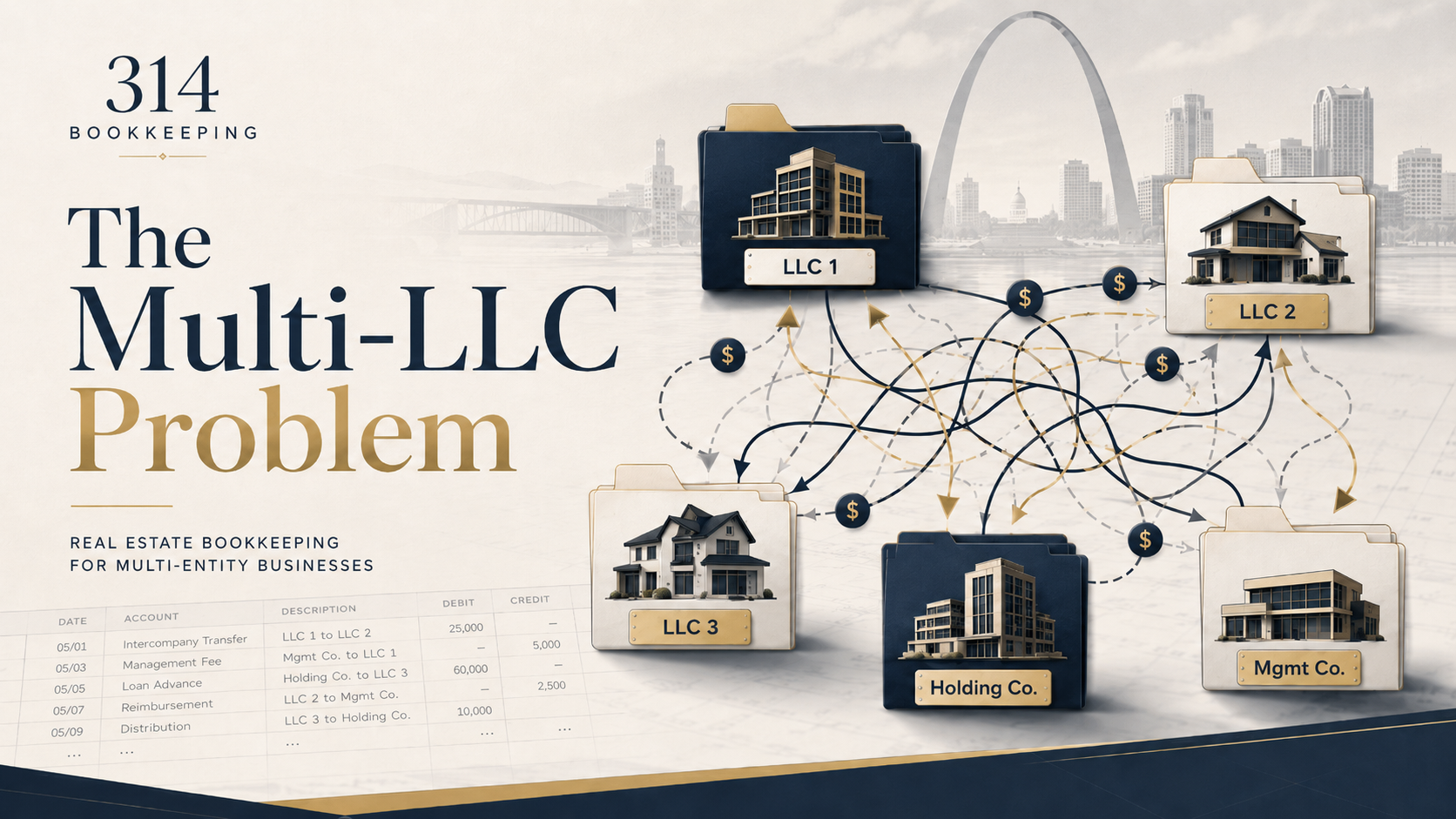
If you're a small real estate developer in St. Louis, you probably aren't running one business. You're running four or five.
One LLC for the residential flip on Morganford. Another for the mixed-use building you're developing in Benton Park. A holding company that owns the land. Maybe a management entity that collects the rents. That structure makes complete sense from a liability and asset protection standpoint — and most experienced developers wouldn't do it any other way.
But here's what often gets overlooked: every one of those entities needs its own clean set of books.
Why Small Developers Use Multiple LLCs
The multi-entity structure isn't just legal strategy — it's a practical necessity for anyone running more than one deal. The reasons are straightforward:
Liability isolation. If one project goes sideways, creditors can't easily reach assets held in a separate LLC.
Lender requirements. Many commercial lenders require a single-purpose entity (SPE) for each deal they finance.
Investor clarity. If you have equity partners in one project, you don't want them having any claim to — or visibility into — your other deals.
Tax planning. Separate entities allow for cleaner cost segregation studies, depreciation elections, and gain/loss tracking at the deal level.
The liability and legal arguments for this structure are well-established. The bookkeeping implications are less often discussed — and they're where a lot of St. Louis developers quietly run into trouble.
The Bookkeeping Problem Nobody Talks About
Running multiple LLCs means you're not just a developer. You're the operator of a small financial ecosystem. Money flows between entities constantly — construction draws, management fees, intercompany loans, capital contributions, distributions. And if no one is tracking those flows with any discipline, the books stop reflecting reality surprisingly fast.
Here's what I see most often when I start working with a developer who hasn't had dedicated bookkeeping:
Intercompany transfers with no documentation. Cash moves from the holding entity to the project LLC to cover a draw, but it isn't recorded as a loan or a contribution. It sits in an unclassified account. Three months later, nobody remembers what it was.
Intercompany loans that were never recorded as loans. This matters more than it might seem. If your holding entity advances $75,000 to a project LLC and that advance isn't properly documented as a loan — with terms and an interest rate, even if it's nominal — you can have serious issues at the deal level: inflated equity in one entity, understated liability in another, and a tax problem that your CPA has to unravel at year-end.
No project-level P&L. When all your activity runs through one QuickBooks file without class or location tracking, you can't see how any individual deal is performing. You know the total revenue and the total expenses. You don't know which project is carrying the others.
Books that don't match the deal. By the time a refinance, a sale, or a 1031 exchange comes up, the financials need to tell an accurate story. If they don't — if the numbers don't reconcile to the bank statements, if the cost basis is wrong, if intercompany activity is unaccounted for — you're looking at an expensive cleanup under deadline pressure.
Why This Matters Beyond Just "Keeping Good Records"
Clean entity-level bookkeeping isn't an accounting preference. It's a practical business requirement for any developer who plans to grow.
Lenders look at it. When you refinance or seek construction financing, your lender wants to see entity-level financials: a P&L for each LLC, a balance sheet that accurately reflects what's owed and what's owned, and documentation supporting the numbers. Disorganized books — or books that clearly don't reconcile — raise red flags in underwriting.
Title companies look at it. At closing, the title company needs a clear picture of how the deal is structured and what encumbrances exist. If your books are a mess, that clarity is harder to establish and closings get delayed.
Your CPA needs it. Even if you've got a great tax professional, their ability to minimize your tax liability is directly tied to the quality of the records you hand them. When books are disorganized, CPAs spend time reconstructing — time you're paying for — instead of strategizing.
Your own decision-making depends on it. Do you know, right now, which of your active deals is performing and which is underperforming? If your books are consolidated or incomplete, the honest answer is probably no. Clean project-level reporting isn't just about compliance. It's about knowing where you actually stand.
What "Clean Books" Actually Looks Like for a Multi-Entity Developer
A well-maintained bookkeeping setup for a St. Louis developer running multiple LLCs typically includes:
Separate QuickBooks Online files for each active entity (or at minimum, class/location tracking that allows entity-level reporting from a consolidated file)
Intercompany loans documented with a loan register, interest rate, and repayment terms — even between related parties
Monthly reconciliations on every bank and credit card account across all entities
Draw tracking by line item matched against the draw schedule and budget
A/P and vendor tracking that supports 1099 filing at the entity level — because each LLC has its own contractor relationships and its own 1099 obligations
A monthly close that produces a P&L and balance sheet for each entity, every month, on a consistent schedule
This isn't a complex system. It's a disciplined one. The value comes from doing it consistently, month after month, so that when a lender, a CPA, a title company, or a potential equity partner asks to see the books, the answer is ready.
The Cost of Waiting
The most common time I hear from developers about their bookkeeping is when something forces the issue: a refinance application, a looming tax deadline, or a deal that's ready to close. At that point, cleanup is urgent — and urgent cleanup is expensive.
Reconstructing 12 months of disorganized books across three entities isn't a weekend project. It takes time, it delays the transaction or filing it's tied to, and it surfaces problems that could have been prevented or managed differently if caught earlier.
The developers who avoid this are the ones who treat bookkeeping as infrastructure rather than overhead — something that runs in the background every month so that nothing is ever more than 30 days out of order.
How 314 Bookkeeping Works With Real Estate Developers
314 Bookkeeping is a St. Louis-based firm focused on bookkeeping for small businesses and real estate developers. I'm not a CPA, and I don't try to be. My role is to make sure your books are clean, your entities are properly separated, and your CPA has what they need to do their job without spending your money on cleanup.
For developers, that typically means:
Monthly close across all active entities
Intercompany tracking and documentation
Draw tracking and job cost reconciliation
1099 prep by entity at year-end
Cash flow forecasting and a monthly reporting package your lender, CPA, or investors can rely on
Pricing is flat-rate and published. No contracts, no hourly surprises, no ambiguity about what you're paying for.
If your books are behind, we handle that too — catch-up work is a fixed fee based on the backlog, not an open-ended hourly engagement.
Ready to Get Your Books in Order?
If you're a St. Louis real estate developer managing multiple LLCs and you've been meaning to get your bookkeeping straightened out, the best time to do it is before you need it — not the week a refinance closes or a tax deadline hits.
I offer a free 30-minute call to look at where things stand and give you an honest assessment of what it would take to get current. No pitch, no pressure — if it's not a fit, I'll tell you.
brandon@314bookkeeping.com | 636-577-0639 | www.314bookkeeping.com
314 Bookkeeping serves small businesses and real estate developers in St. Louis City and the surrounding metro area. Clean Books | Consistent Close | Reporting You Trust.

The Business Owner's Juggling Act: Websites, Taxes, and Everything In Between
Nobody warns you about the website.
You start a business because you're good at something — a trade, a service, a skill that people will pay for. You do the paperwork, set up an LLC, maybe print some business cards. And then someone asks: "What's your website?"
Suddenly you're watching YouTube tutorials on web design at 11pm, trying to figure out why your logo looks pixelated and whether you need a privacy policy. This wasn't in the business plan.
Welcome to small business ownership in 2026, where being good at your craft is just the starting point. The job now also requires you to be a marketer, a web developer, a customer service rep, a compliance officer, and somewhere in there — a bookkeeper.
Most owners handle the website eventually. It's the financial side that tends to quietly unravel while everything else is getting attention.
The Hidden Complexity of Running a Business
The challenges that blindside new business owners most aren't the big strategic ones. They're the operational details that pile up in the background:
How do I build a website that actually shows up on Google? Website builders like Squarespace and Wix have made it possible for anyone to get online, but SEO — the work that makes your site findable — is a discipline of its own. Keywords, metadata, page speed, backlinks: it takes real time to learn and maintain.
When do I need to pay taxes, and how much? If you're self-employed or running an LLC, you're responsible for quarterly estimated tax payments to the IRS. Miss them, and you'll owe penalties on top of the taxes themselves. Knowing what you owe — and having the cash on hand when it's due — requires clean, up-to-date financial records throughout the year, not just in April.
What can I actually deduct? The tax code gives small business owners legitimate deductions: home office, mileage, equipment, software, professional services. But claiming them requires documentation. A mileage log. Receipts. Properly categorized expenses in your books. Without that infrastructure, you're either leaving money on the table or guessing — neither of which is a good position to be in.
Am I actually profitable? This sounds like a question with an obvious answer, but many small business owners genuinely don't know. Revenue coming in feels like success, even when expenses are quietly eating the margin. You can't answer this question accurately without a reliable profit and loss statement — and you can't have that without organized books.
Why Bookkeeping Is the First Thing to Delegate
Every business owner has to make a decision at some point: what do I do myself, and what do I hand off?
Websites are learnable. Marketing is learnable. Even basic HR has tools that guide you through it. But bookkeeping has a compounding quality that makes DIY particularly risky. Mistakes made in January show up in April. Transactions that weren't categorized correctly in Q1 distort every report you run for the rest of the year. By the time you realize something is wrong, there's months of cleanup to do.
A bookkeeper doesn't just keep your records tidy. They give you something more valuable: clarity. When your books are current and accurate, you can see exactly where your money is going. You know what your margins are. You know whether you're on track for the quarter. You can make decisions from real numbers instead of gut feelings.
And when tax season comes, instead of dreading it, you hand your CPA a clean file. No shoebox of receipts. No months of reconstruction. Just organized records that make the filing process straightforward — and keep your accounting bill as low as possible.
The Practical Reality
Running a business in 2026 means accepting that you will wear multiple hats, especially early on. You'll figure out the website. You'll learn the basics of social media. You'll get better at sales conversations. That's all part of the entrepreneurial experience, and there's real value in building those skills.
But financial records are not the place to figure things out as you go. The cost of disorganized books isn't just time — it's money you didn't collect in deductions, tax penalties you didn't see coming, and decisions you made without the information you needed.
The business owners who grow sustainably are the ones who get their financial foundation right early. A dedicated business bank account. Clean transaction records every month. A bookkeeper who keeps it all in order so you can focus on everything else.
You don't have to do all of it yourself. The website, yes. The books — let someone else handle that.
If your financials need some attention, I'm here.

Why Mixing Personal and Business Finances Is Costing You More Than You Think
One of the most common mistakes I see small business owners make isn't a bad hire or a missed invoice. It's something far more mundane — and far more damaging.
They run everything through one bank account.
Personal expenses mixed in with business transactions. The occasional personal credit card used for a business purchase. A business account that doubles as a personal emergency fund when things get tight.
It seems harmless. Until it isn't.
The Hidden Cost of Commingled Funds
Most business owners who commingle finances aren't doing it out of carelessness — they're doing it out of convenience. When you're first starting out, opening a separate account feels like overkill. You know what's personal and what's business, right?
The problem is that your bookkeeper, your CPA, the IRS, and a judge in a liability case don't have that same context. They only see the transactions.
Here's what commingling actually costs you:
Your books become unreliable.
When personal and business transactions are tangled together, your profit and loss statement doesn't reflect reality. You might think you had a strong month — but how much of that revenue was offset by personal spending that never got categorized correctly? You can't make good decisions from numbers you can't trust.
Tax season turns into an expensive project.
Your CPA charges by the hour. When they have to reconstruct months of mixed transactions — figuring out which Amazon charges were office supplies and which were birthday presents — that's billable time that could have been avoided entirely. Clean books going into tax season can save you hundreds, sometimes thousands, in accounting fees alone.
You quietly erase your liability protection.
This one catches people off guard. If you're operating as an LLC, the entire point of that structure is to create a legal separation between you and your business. Creditors can come after the business — not your personal assets. But that protection isn't automatic. Courts look at whether you've actually been treating the business as a separate entity. Commingling funds is one of the clearest signals that you haven't been. It's called "piercing the corporate veil," and it can expose your personal assets — your savings, your house — to business liabilities.
The Fix Is Simpler Than You Think
You don't need a complex accounting system to solve this. You need three things:
A dedicated business checking account — used exclusively for business income and expenses.
A business credit card — for any business purchases that go on credit, earning rewards and keeping a clean paper trail.
A bookkeeper who reconciles the two accounts monthly and flags anything that looks out of place.
That's it. With those three pieces in place, your books are reliable, your CPA has what they need, and your legal protection stays intact.
Clean Books Start With Clean Accounts
If your financials are a little tangled right now, you're not alone — and it's fixable. The goal isn't perfection from day one. The goal is a clear, consistent system going forward.
If your books could use some clarity, I'd be glad to help.